




















- Best of All
- Best Miami Luxury Condos
- Most popular
- Relocating to Miami
- Private Schools
- Investments
- Gated communities
- Waterfront information
- Luxury homes
- Luxury Condos
- New Construction Condos in South Florida
- Independent Pre-Construction condo reviews for Miami
- Independent Pre-Construction condo reviews for Fort Lauderdale
Coconut Grove Real Estate Market Q1 2026
The ugly truth is Coconut Grove is expensive and only getting more expensive.
Coconut Grove Market Analysis by David Siddons
This report is part of a 12-part series of in-depth market analyses by David Siddons, a Miami-based real estate advisor specializing in relocation and luxury residential markets. His work focuses on interpreting pricing trends, supply dynamics, and buyer behavior across key neighborhoods such as Coconut Grove, Coral Gables, and Pinecrest, providing clients with a structured, data-driven framework for making real estate decisions.
This report is co-audited by David Vazquez, a real estate advisor with the David Siddons Group whose expertise is rooted in one of Miami’s most nuanced and desirable residential markets. As a resident of Coconut Grove, he brings both professional insight and personal perspective—understanding the neighborhood not only through data, but through the day-to-day realities that define its lifestyle, from its walkable streets and waterfront setting to its distinct micro-markets.
Unlike general market updates, this analysis is designed to break down the underlying forces shaping value in Coconut Grove. By examining inventory trends, pricing dynamics, and shifts in buyer behavior, it provides a clear view of how the market is evolving—helping buyers and sellers identify where opportunities exist and where greater selectivity and strategy are required.
Introduction
Coconut Grove has long occupied a unique position within Miami’s residential landscape. It is not simply another neighborhood experiencing the ebbs and flows of the broader housing market; it is a lifestyle-driven enclave where demand is shaped as much by quality of life as by financial considerations. With its canopy-lined streets, proximity to Biscayne Bay, and a blend of historic charm and modern architecture, the Grove has consistently attracted buyers seeking something that feels both established and enduring. Yet even in a market defined by scarcity and desirability, cycles exist. Inventory levels shift, pricing power evolves, and different segments of the market begin to move at different speeds.
Over the past several years, Coconut Grove experienced a period of extraordinary demand, fueled by wealth migration, lifestyle shifts, and historically low interest rates. During that phase, buyers competed aggressively for limited inventory, and pricing moved rapidly upward across many segments of the market. Today, however, the environment is more nuanced. Demand remains present, but buyers have become more analytical, negotiating dynamics have shifted, and the market is beginning to differentiate more clearly between properties that justify premium pricing and those that require adjustment. In other words, the Coconut Grove market is no longer defined by a single narrative — it is defined by segmentation, selectivity, and strategy.
This report examines the current state of the Coconut Grove condominium and single-family home markets through a data-driven diagnostic framework. By analyzing inventory levels, pricing trends, absorption patterns, and buyer behavior, the goal is not simply to describe what has happened, but to understand what the market is signaling about the months and years ahead. Because in a neighborhood as competitive and complex as Coconut Grove, the difference between a good decision and a great one often comes down to the depth of insight guiding it. There are 10 key points to discuss, so let’s dive into it.
1 The Coconut Grove Market Has Slowed From Its Pandemic Frenzy — But It Is Far From Weak
Coconut Grove overall is a very even market but to truly understand the market, we have to dive into the details and separate market behavior by price points. Below $3M is a seller’s market, with very little inventory and high demand. Under $3M is the entry point into Coconut Grove which will always carry high demand. Days on market average for this price bracket average at 83 days.
$3M to $6M is a neutral market where we see more of a balance in supply and demand. If a listing is overpriced in this price range, it simply will not sell. On the other hand, a well-done property on a nice lot, will still sell very quickly. Days on market for this price bracket average at 139 days.
In the $6M-$10M and $10M+, properties tend to take longer to sell but there are exceptions. A desirable condo at Park Grove or Grove at Grand Bay could sell in a week. A desirable home walking distance into downtown Grove on a nice lot and custom finished could sell in under 30 days. There are exceptions to each price range but as a whole, above $6M has a longer days on market with days on market for this price range averaging 285 days.
The months of supply across the board in Coconut Grove is 6.5 months showing a very balanced market leaning towards a seller’s market.

Show me the Best Coconut Grove Properties for Sale
2. Pricing Is No Longer Moving in One Direction — The Market Is Now Clearly Dividing
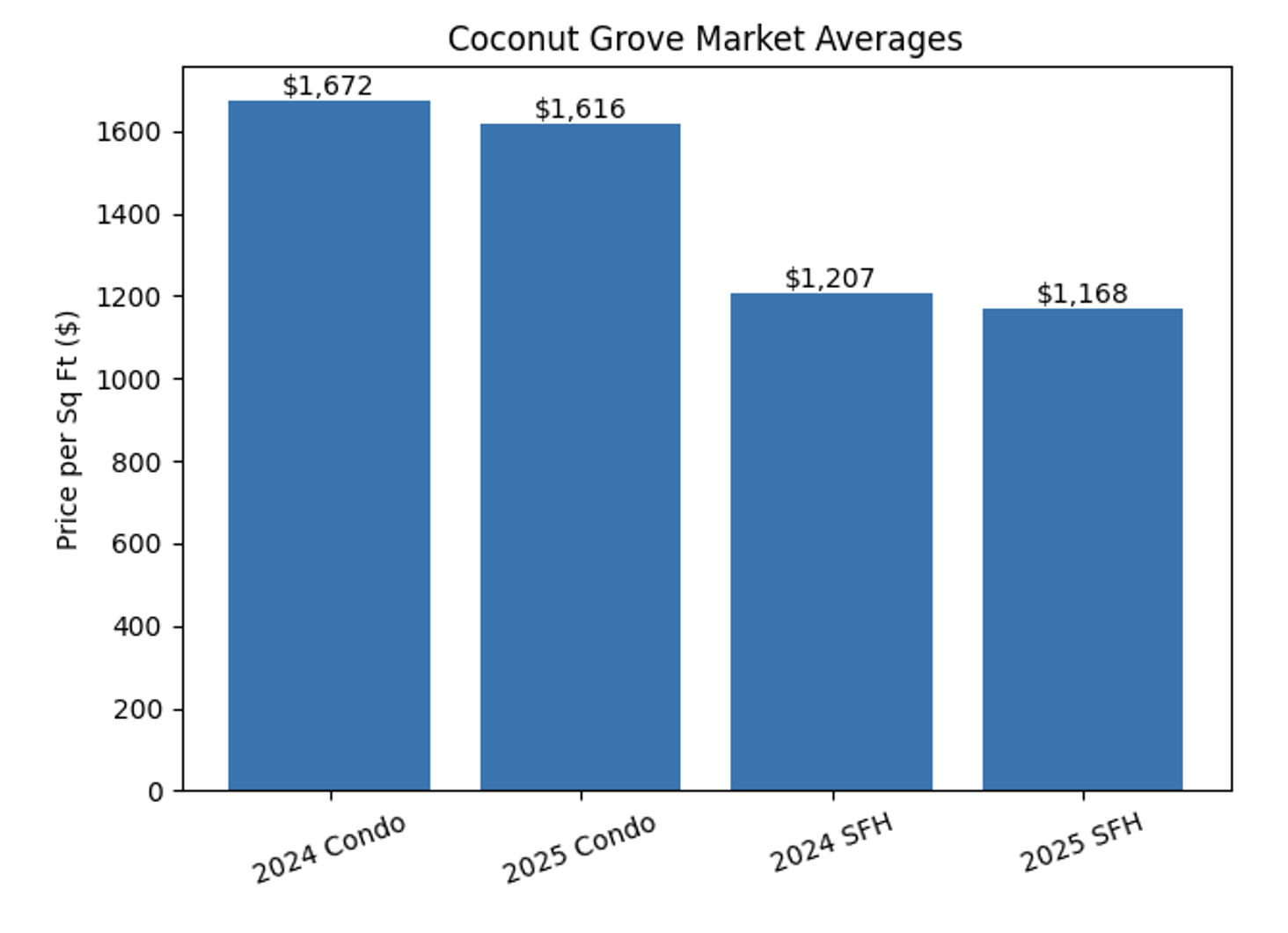
The Coconut Grove market continues to push its boundaries on a price per square foot basis. In the condo market, we have One Park Grove now pushing almost $4,000 per square foot for a fully renovated unit. The new Four Seasons Residences that will be delivered in 2028 comprised of 70 units starts at $3,500 per foot and many units selling at $4,00 per square foot or more. These are staggering numbers for Coconut Grove and represent the top of the market. The condo market averaged $1,672 per square foot in 2024, a 10% increase from the prior year. In 2025, the average price per square foot was $1,616, a slight 3.47% pullback. While the top of the market continues to push pricing, some of the older buildings with outdated properties have become more flexible on pricing as buyers are looking for a turn key finished product.
In the single family home market, the average price per square foot in 2024 was $1,207 and $1,168.23 in 2025, a pullback of 3.3%, very similar to the condo market. It may seem that the market is softening slightly with these numbers but what we see is a market readjusting for the better. True sellers have become more realistic and are no longer seeking post pandemic record breaking numbers. However, the few phenomenally finished homes in excellent locations will still break records today such as Park Grove 15A selling for $3,850 per foot, 3849 Leafy Way selling for $2,144 per square foot and 3976 Little Ave selling for $2,043 per square foot. Premium properties in excellent locations and custom finished are still breaking records.
3. Supply Remains Limited Today — But the Pipeline Suggests More Competition Ahead
For single family homes, the supply continues to be low throughout as buyer demand stays extremely high and the lack of new inventory comes on the market. There isn’t any land to build new homes but rather tear down an old home and build a new more functional property to today’s standards. This does not add supply however it just replaces old with new.
When it comes to the condo market, there is slightly more supply coming in the next few years which will improve the short inventory, but it will not move the needle too much. From 2026 to 2028, there are less than 400 new condos that will be injected into the Coconut Grove condo market with buildings such as Four Seasons and The Well Coconut Grove. Given the lack of overall condo inventory in the market, this will not change much and the condo market will continue to thrive moving forward.
4. Turnkey Properties Are Setting the Pace — Renovation Projects Are Losing Momentum
Without question, a well-finished property not only demands a premium but also sells quickly. A well-done property does not necessarily mean a new property however. Some of the new “spec” finishes are no longer cutting it for discerning buyers. A well-done home is a custom finish with custom millwork, lighting, wallpaper, smart home upgrades, properly landscaping and the attention to detail. When a rare property hits the market and checks these boxes, it does not last long on the market.
Land is also in very high demand in Coconut Grove. Because land does not exist, land means a tear down where the land is worth more than the structure itself. These properties are in very high demand as buyers and developers are desperately looking for these opportunities to build their dream home. When priced correctly and located on a good street, land trades can demand multiple bids in a short period of time.
The properties that seem to struggle the most are the “in-betweeners”. This is when a property is not considered a tear down but it not newly renovated. It is in that in-between stage and is often the hardest to sell because a seller usually want to demand top dollar and a buyer usually wants to fully renovate, often leaving a gap in price where buyer and seller agree on price.
5. Many Sellers Are Still Pricing for Yesterday’s Market
Pricing is the most important strategy when selling. Correctly pricing a property allows you maximum leverage which leads to selling a property for the most amount of money possible. While demand is high and inventory is low, an overpriced listing will still sit on the market in today’s market. Buyers are savvy and knowledgeable today.
6. Coconut Grove Remains a Lifestyle Premium — But Buyers Still Compare It to Nearby Alternatives
When looking in Coconut Grove, buyers often look into similar neighborhoods such as Coral Gables, High Pines, South Miami and Pinecrest. The buyer pool for these areas are generally growing families that are looking for space for kids, both living area and outdoor living space.
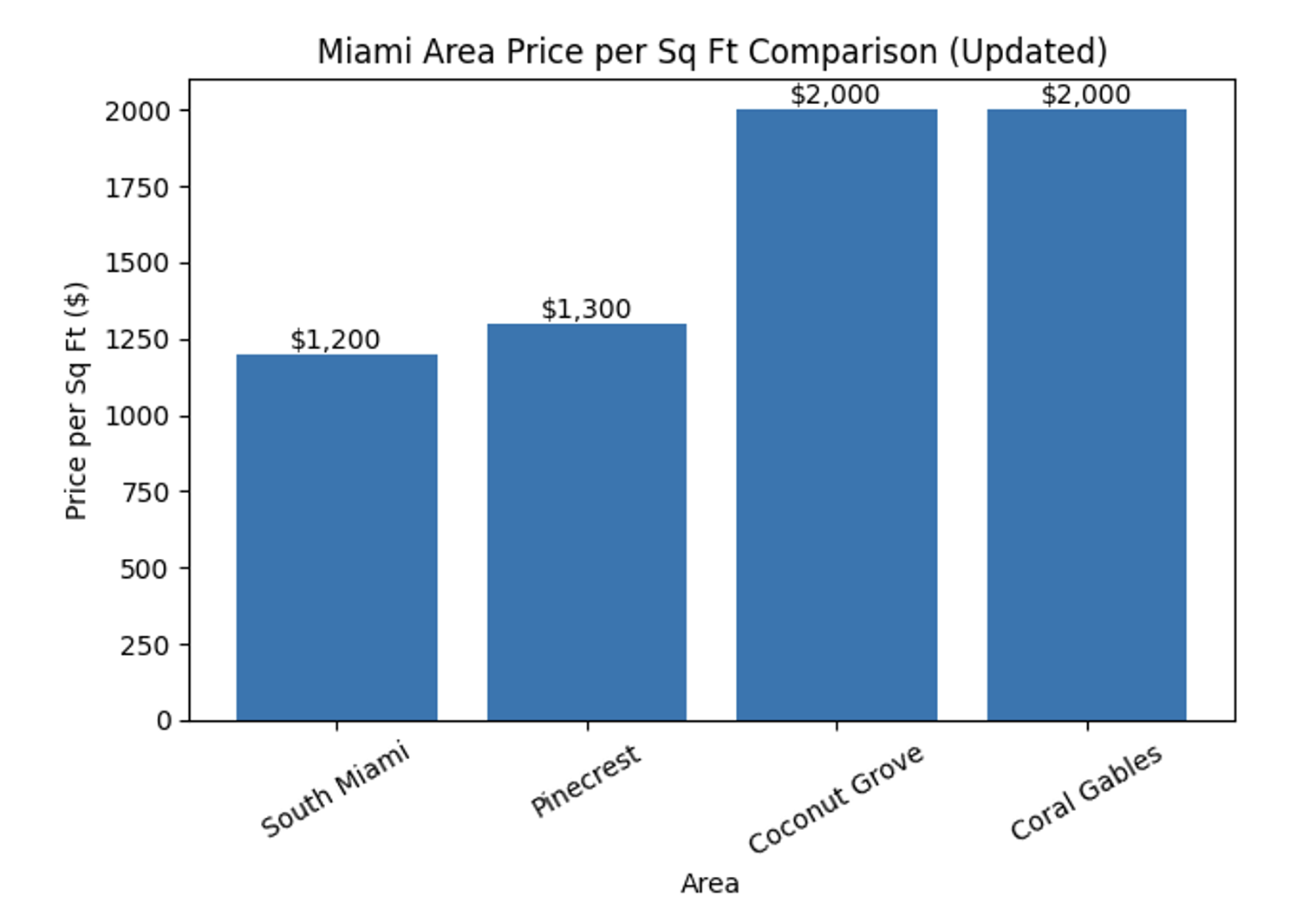
Coconut Grove is usually but not always the first choice because of the lifestyle that includes the beautiful downtown village of Coconut Grove, the proximity to other neighborhoods such as Brickell and Coral Gables and being centrally located for schools. But, buyers that are looking for more land, larger homes and larger properties in general may go for properties in South Gables, Ponce Davis and South Miami. In south Coral Gables and Ponce Davis, price per square foot goes toe to toe with Coconut Grove, around $2,000 per square foot for a custom finished property, top end of the market. In South Miami and Pinecrest, there is more value as $1,200 per square foot represents the top end of the market.
7. Higher Interest Rates Have Not Stopped Buyers — They Have Simply Changed Who the Buyer Is
In Coconut Grove, sticky higher interest rates have not stopped buyers but they have changed the type of buyer and buyer behavior. In today’s “higher interest rate environment”, the marginal buyers are still sitting on the sidelines. Serious, long term buyers are taking action. The behavior of buying varies throughout the different price points. In the sub $3M market, buyers are still acting quickly as this is the entry market into Coconut Grove and it is very competitive. In the $3M to $6M range, buyers act more cautiously and we see sellers are more willing to negotiate in this price range. In the $6M to $10M range, a custom finished home will still demand high interest and buyers recognize this and act quickly, often offering cash on the contract but closing with financing. Overall, the luxury market and buyers are less sensitive to rates because they have the option of buying cash or they can find excellent rates with the private banks such us JP Morgan, Merryl Lynch and Morgan Stanley, much lower rates than the average 30 year interest rate.
8. The Real Risks in Coconut Grove Are Often Hidden Beneath the Surface
SINGLE-FAMILY HOMES: When buying a single-family home in Coconut Grove, you always must be cautious on the following risks:
- Flood zone. Buying a property in a flood zone can increase your insurance costs which can be a financial burden. More importantly, if you fully renovate a home in a street that floods, any large storm can hit and cause serious damage to your property. In a non-flood zone area, this is still a risk but a much more unlikely risk
- Busy roads. Trying to sell a road on a busy road is always a challenge. A buyer may think they are getting a great deal because on a price per square foot basis it’s a huge discount but when selling, the same will always apply. Families try to avoid busy roads because of noise and the danger of cars driving fast with children on the street. Try to avoid a main road or avenue.
- Older homes that may seem renovated. There is nothing wrong with buying an older home, many homes in the Grove often are very old. But, if you are paying a premium for a “renovated” home, make sure the rough work or the work not seen to the naked eye was also renovated which include electrical wiring, replacement of cast iron pipes, replacement of old AC ducts and septic tank and drain field if applicable.
CONDOS carry different risks such as:
- Special Assessments in Older Buildings
- Has the building passed its 40 year recertification?
- Has the building passed its SIRS?
- Does the building have a well-funded reserve account for any upcoming improvements?
Typically in newer buildings, these problems are not an issue. But any condo built before 2000 must be analyzed closely.
9 Waiting for the “Perfect Moment” Can Be the Most Expensive Strategy in Real Estate
When buying, it is almost impossible to predict and “time the market”. In very stable markets such as Coconut Grove, the best time to buy is always now. In almost every scenario, a buyer always feels they are paying at the “top of the market” at the time of their purchase and in almost every scenario, they look back a few years later and are so happy they purchased at the time they did. Real estate in stable and prime markets such as Coconut Grove will only continue to appreciate over a long period of time. It is simple supply and demand, there is limited inventory that cannot be added because of land constraints and increasing demand for families looking to relocate to Coconut Grove whether local or out of state.
When selling, timing and strategy play a bigger role. During Coconut Grove’s winter months, we welcome our seasonal clientele into town escaping the cold from areas such as NYC, Boston, Connecticut, Chicago, New Jersey, DC and all over the Americas. During these months, we see more buyers shopping around compared to the slower summer months. This is especially true if trying to sell a condo rather than a single family home. Seasonal buyers are often looking for a condo rather than a large home.
10. Coconut Grove Today Rewards Long-Term Owners — Not Short-Term Speculators
Coconut Grove continues to lure in buyers locally and from all over the country. In the last year, we have helped buyers from Canada, Chicago, Boston, California, Washington and New York. It is a true diversified neighborhood and friendly neighborhood welcoming of residents from all walks of life. Most of the buyer profiles are the same which are families looking for safety, quality of life, social with friends and looking for great schools. These buyers are not looking to make a quick flip but looking to buy for the long term. This behavior is true throughout the Grove market which is what keeps inventory so limited.
Conclusion on the Coconut Grove Real Estate Market Q1 2026
The Coconut Grove residential market remains one of Miami’s most resilient and desirable lifestyle markets, but it is increasingly defined by selectivity rather than broad momentum. Well-positioned properties — particularly renovated homes, scarce floor plans, and newer condominium inventory — continue to attract serious buyers. At the same time, pricing power is no longer universal, and success in today’s environment depends on understanding how inventory, pricing trends, and buyer behavior are evolving within each segment of the market.
For buyers, this environment offers a more strategic landscape than the competitive conditions of recent years, with opportunities emerging for those who understand where negotiation leverage exists.
For sellers, the opportunity remains strong, but it requires accurate positioning and alignment with current market data rather than past peak expectations. In both cases, the difference between a good outcome and a great one often comes down to having the right market intelligence before making a move.
If you are considering buying or selling in Coconut Grove, the David Siddons Group would be happy to provide a deeper analysis of your property, building, or investment objectives. Because in a market defined by nuance and scarcity, the real advantage is not timing the market — it is understanding it before everyone else does.
What Relocation Buyers Need to Know — and How David Siddons Adds Value
Relocating to Coconut Grove requires a different level of understanding than most Miami neighborhoods. This is a market defined by lifestyle, scarcity, and micro-location—where pricing can shift dramatically from one street to the next, and where the difference between a strong purchase and an average one often comes down to nuance.
Many relocation buyers are drawn to the Grove for its walkability, waterfront access, and architectural character, but navigating the market requires more than recognizing its appeal. It requires understanding which pockets command long-term demand, how to evaluate older homes versus new construction, and how to interpret pricing in a market where no two properties are truly alike.
David Siddons advises relocation buyers by combining data-driven analysis with deep local market insight. His approach focuses on identifying where value exists within a highly segmented market, guiding clients through property selection, and structuring offers that reflect current market dynamics—not just listing prices. The goal is not just to secure a property, but to ensure it aligns with both lifestyle goals and long-term positioning.
With extensive experience advising relocation clients into Miami’s most competitive neighborhoods, David provides a structured, strategic process that simplifies decision-making and reduces risk.
Part of a Broader Miami Market Analysis
This Coconut Grove report is part of a broader series covering Miami’s key residential markets, including Coral Gables, Pinecrest and other high-demand neighborhoods. Each report follows the same analytical framework, allowing for direct comparison across submarkets and providing a more complete understanding of Miami’s evolving real estate landscape.
Work with David, The Coconut Grove Market Specialist
FAQ
These are the most commonly Miami Real Estate Related questions
1. Why is Coconut Grove real estate so expensive in 2026?
Coconut Grove real estate is expensive due to its unique combination of limited supply, strong lifestyle appeal, and high demand from both local and out-of-state buyers. The neighborhood offers walkability, waterfront access, and a mix of historic charm and modern homes, which continues to attract long-term residents. Limited land availability further reinforces pricing.
2. Is the Coconut Grove housing market slowing down or still strong?
The Coconut Grove market is still strong, but it has become more balanced and selective. While the rapid price growth of the pandemic years has slowed, demand remains steady. Well-priced, high-quality properties continue to sell efficiently, while overpriced or outdated homes are taking longer to transact.
3. What types of homes are selling fastest in Coconut Grove?
Turnkey, fully renovated homes and well-located properties are selling the fastest in Coconut Grove. Buyers are prioritizing design, quality finishes, and move-in-ready condition. In contrast, homes that require significant updates or fall into an “in-between” category tend to experience longer days on market.
4. What are the biggest risks when buying in Coconut Grove?
The biggest risks include flood zone exposure, busy street locations, and hidden issues in older homes such as outdated plumbing or electrical systems. For condos, buyers should evaluate special assessments, reserve funds, and building recertification status. These factors can significantly impact long-term costs and resale value.
5. Should buyers wait for prices to drop in Coconut Grove?
Waiting for prices to drop in Coconut Grove can be a costly strategy due to the neighborhood’s limited supply and long-term demand. While short-term fluctuations may occur, prime properties tend to hold value and appreciate over time. Buyers who wait often miss opportunities, particularly in high-demand segments.
WHY WORK WITH DAVID? THINGS YOU SHOULD KNOW...
For all our analytics we are agents driving some very unique and advanced tech. We Provide a granular and custom experience that empower our clients with the insight and tools to understand the most complex behaviors of any local markets.
-
Analytical
Over 100 reports produced to date
-
Knowledgeable
Over 1800 published articles and counting


Related Articles

Coral Gables Real Estate Market Q1 2026
Kendall Luxury Real Estate Market Update Q1 2026
Miami Real Estate Market Report Q1 2026: The Two-Market Reality Driving Prices

Sunny Isles Real Estate Market Q1 2026

Who Is the Best Real Estate Agent in Miami for New Construction Condos? (2026 Data-Driven Guide)

How to Buy a Luxury Condo in Miami (2026 Playbook for Smart Buyers)

Pinecrest Real Estate Market Update Q1 2026

Aventura Real Estate Market Report Q1 2026

Brickell Real Estate Market Report Q1 2026

Coconut Grove Real Estate Market Q1 2026

South of Fifth Real Estate Market Report Q1 2026
Fort Lauderdale Luxury Real Estate Update Q1 2026 | A Quiet Market Shift is Underway

Best Value Neighborhoods in Miami

Real Estate Investing in 2026: Why the Old Strategies No Longer Work
Please fill in your details and David Siddons will contact you

Search related videos

Are St. Regis Sunny Isles Residences Worth the Brand Premium?
Coral Gables Market Report 2025: What the Headlines Aren’t Telling You!
How David Siddons’ Power Team Drives Miami’s Luxury Market
Mid‑Year 2025 Coconut Grove Report: The Truth About What’s Selling Now
Brickell Mid‑Year Market Report 2025 | Is Brickell’s Luxury Market in Trouble?
Pinecrest Mid-Year Market Report 2025 | What’s Selling, What’s Sitting & Why
Miami Beach Condo Market Mid-Year Report 2025 | What Buyers & Sellers Need to Know
How to Lose $1M in The Miami Condo market | Top Mistakes That Cost Miami Condo Buyers Millions
The Well Project EXPOSED Coconut Grove’s Hottest Units
Miami Real Estate in 2025 Is NOT What You Think 😱 | Midyear Must Knows for Buyers & Sellers!
7 Things You Should Never Say to a Real Estate Agent in Miami!
Landmark Victoria Park Residence in Fort Lauderdale: Inside 420 NE 11th Ave 🌴✨
Luxury Living on 2355 S. Miami Ave | Fully Furnished 4-Bed Home w/ Resort-Style Pool 🏊
Is Mandarin Oriental Residences Miami a Smart Condo Investment? Prices, Floorplans, Views & Finishes



- Get our Newsletter
- Subscribe
- No Thanks
Get the latest news from Miami Real Estate News
Close
Edit Search
Close
Share this property
Recomend this to a friend, just enter their email below.
Close
Your email was sent successfully
Close
 COMPARE WITH CONDOGEEKS
